
Fundamentals
The 3-Level Alignment Model: My Kickoff Framework for Projects That Actually Get Going
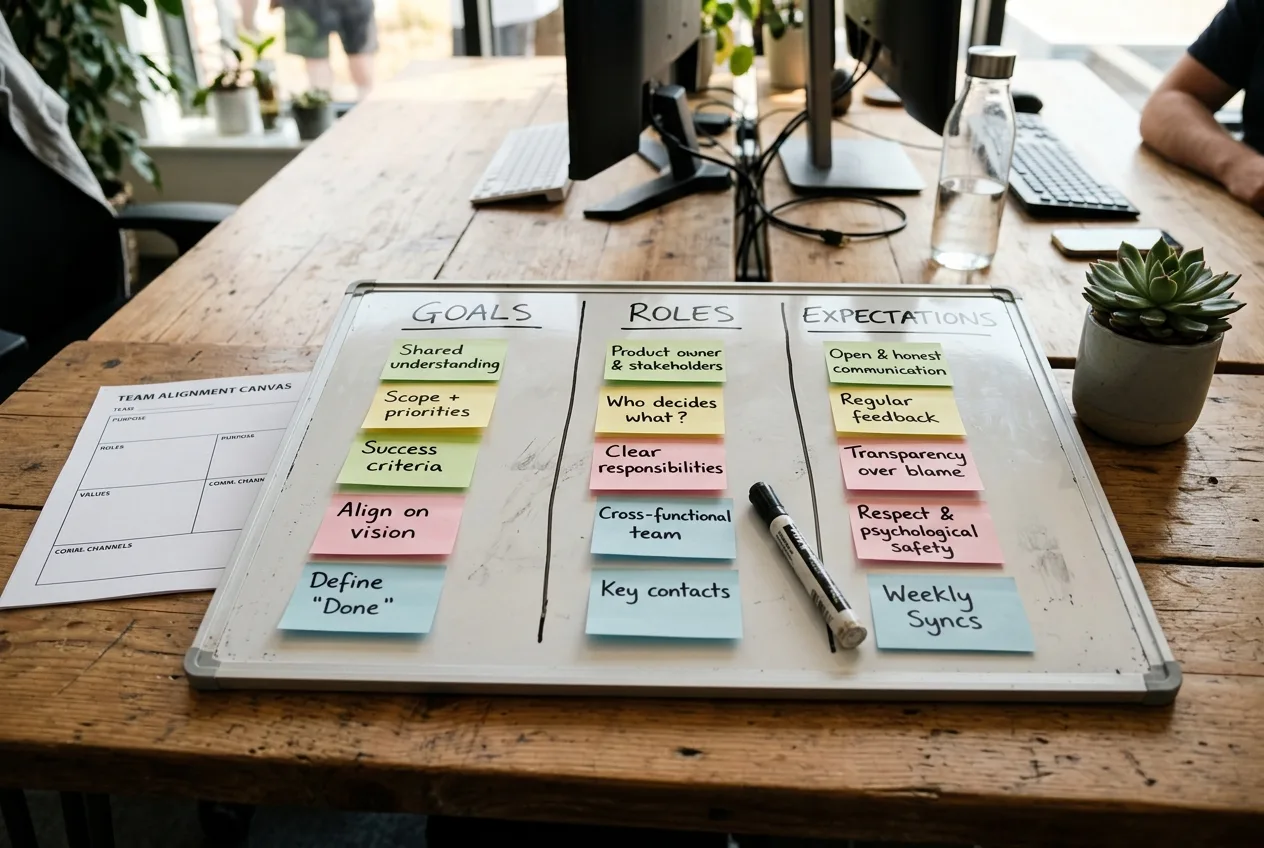
30 April 2026
The Three Levels of Alignment
Level 1: Goal Alignment — What is this for?The first and most important question is not a planning question. It is a question of purpose.
What should be different at the end? Not what gets delivered, but what changes. For whom? Why now?
Guiding questions for Level 1:→ What is the concrete benefit if this project succeeds?
→ How will we know in 6 months that it worked?
→ What happens if we don't do it?
→ Where do we agree, and where do expectations still differ?
This step sometimes takes an hour and reveals that two stakeholders expect fundamentally different things. That is not bad news. It is the best news a kick-off can deliver.
Level 2: Role Alignment — Who decides what?
Accountability is the most common blind spot in kick-offs. Org charts show the hierarchy, but not who decides what within the project.
Guiding questions for Level 2:→ Who has the final say on content decisions?
→ Who has the final say on budget and timeline decisions?
→ What can the team decide on its own — without escalation?
→ Who is the go-to contact for external stakeholders?
→ What happens if someone is unavailable?
Level 3: Expectation Alignment — How do we want to work together?The third level is skipped most often — and causes the most friction.
Guiding questions for Level 3:→ What do I expect from this team — and what do I offer in return?
→ How should feedback work between us?
→ What is our shared definition of “done”?
→ How do we escalate when something is wrong?
→ What is our communication rhythm?
The Model in Practice
I run the 3-Level Alignment as a facilitated workshop — 2 to 3 hours, depending on the complexity of the project. Three rules apply:
1. I take live notes (whiteboard or shared document) — so everyone sees the results as they emerge
2. Everyone is free to say anything — including uncomfortable expectations
3. At the end, everyone signs off a shared canvas, which we revisit at the next milestone
The Alignment Canvas — Ready to Print
Here is the canvas as a fillable template. I always hang a printed A4 copy in a prominent spot during my workshops.
Tip: Copy it into Confluence or Notion as a page — then everyone can edit it at the same time.
Download the 3-Level Alignment Canvas (PDF)
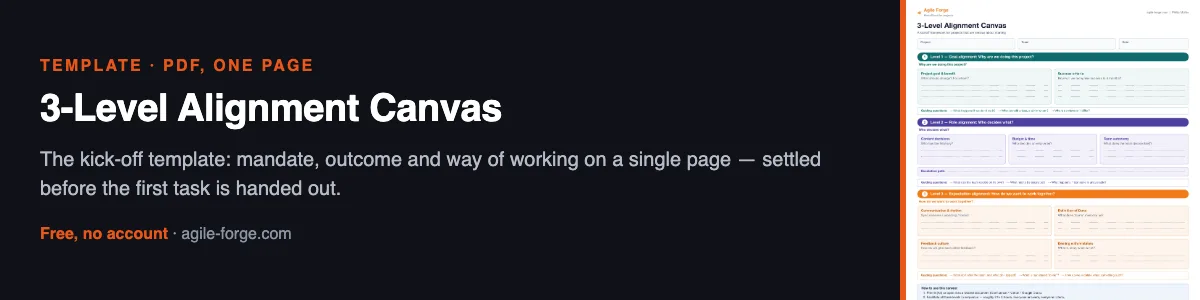
Opens straight away, no account
The canvas is deliberately short. No 20-page project manual. One sheet you can print out, pin up, or copy into Confluence. Its value lies not in filling it in, but in the conversation it starts.
Related course
Choosing your agile approach
Setting up the kickoff, roles and expectations properly: in the course you practise this on an end-to-end project scenario.
View the course →
Philip Müller
Trainer and consultant for project management, agile methods and AI in day-to-day project work.
About the author →Newsletter
What actually works in day-to-day projects, roughly once a month.
New articles, tools, and what has held up when using AI on real projects. No sales talk, no roundup of news you have already seen.
I would like to receive occasional emails from Agile Forge about courses, new content and offers. You can unsubscribe at any time with one click. I never pass your address on. Read the privacy policy