
Fundamentals
The Cynefin Framework: Why the Situation Determines the Method
16 July 2026
What is Cynefin?
Cynefin (pronounced: ku-NEV-in, Welsh for “habitat” or “environment”) was developed by Dave Snowden in the late 1990s. It is neither a process model nor a project method.
Cynefin is a sensemaking framework.
In other words, a tool that helps you better understand situations before deciding how to act.
The underlying idea is simple:
Not every problem is the same.
Some situations have obvious solutions. Others require expert knowledge. Still others can only be understood by trying things out and learning. And sometimes there is simply chaos.
Cynefin distinguishes four fundamental domains as well as a state of confusion.
The Cynefin Framework at a Glance

Source: Snowden, D. J. (Cynefin Framework / Cognitive Edge materials)
The Cynefin Framework by Dave Snowden. Different situations call for different approaches.
PDF Download
Want to look up the model again later?
Download the Cynefin quick reference (PDF)
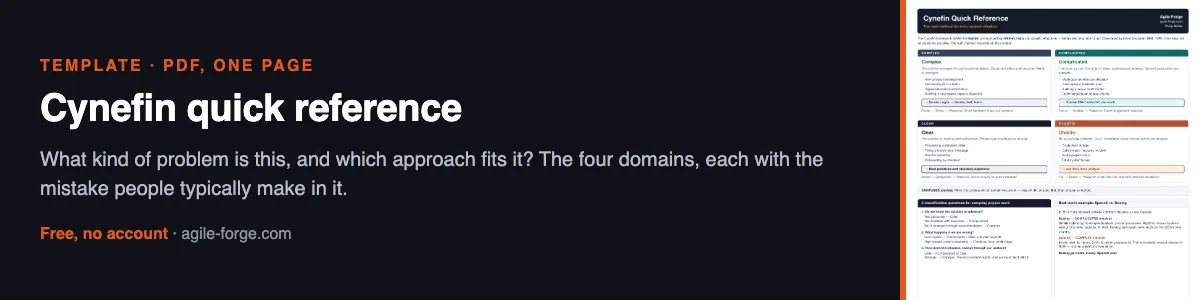
Opens straight away, no account
1. Clear
Cause and effect are obvious. Everyone recognises the connection. There are proven solutions that work reliably.
Examples:
- Executing a standard process
- Fixing a known error
- Processing a form
Appropriate response:
Sense → Categorise → Respond
What helps here?
Standards, checklists and established processes.
Do we need agile methods here?
Usually not. When the solution is already known, additional meetings often create more overhead than value.
2. Complicated
Cause and effect are linked, but not in an obvious way. It takes analysis, expertise or multiple experts to find the best solution.
There are several possible answers – each with different pros and cons.
Examples:
- Designing the architecture for a new system
- Creating a business plan
- Planning a bridge
Appropriate response:
Sense → Analyse → Respond
What helps here?
Expertise, analysis and structured planning.
Do we need agile methods here?
Possibly, but they are not essential. Traditional project planning or other structured approaches are often sufficient.
3. Complex
This is where it gets interesting.
In complex situations, cause and effect can only be recognised in hindsight. The solution is not known at the outset.
This means: you cannot fully analyse your way to the right answer.
You have to discover it.
Examples:
- Developing a new product idea
- Integrating AI into a team
- Building an innovative business model
Appropriate response:
Probe → Sense → Respond
What helps here?
Experiments, short feedback loops and continuous learning.
Do we need agile methods here?
Iterative and adaptive approaches were developed precisely for situations like these.
When the solution is not known in advance, it often only emerges during implementation.
4. Chaotic
In chaotic situations there is no discernible link between cause and effect.
Analysis doesn't count. Action does.
Examples:
- Production outage
- Cyber attack
- Acute project crisis
Appropriate response:
Act → Sense → Respond
Establish stability first. Then analyse.
Do we need agile methods here?
No. In genuine crises, what is needed is fast decisions and clear accountability.
5. Confused (Disorder)
The centre of the model is not a problem type but a warning signal.
We do not yet know what kind of situation we are dealing with. And this is precisely where many poor decisions originate.
If we misjudge the situation, we often choose the wrong approach as well.
SpaceX and Boeing – this time through the Cynefin lens
In the last article I told the story of SpaceX and Boeing.
Viewed through the Cynefin lens, at least one interesting hypothesis emerges. Perhaps the difference was not that one side had better engineers.
It may have been how each side handled uncertainty.
In complicated situations, planning, specifications and expert knowledge are helpful.
In complex situations, they are often not enough on their own.
Experiments, feedback and learning then become an additional success factor.
Whether that is precisely what explains the difference between SpaceX and Boeing cannot be answered with certainty from the outside.
But the comparison shows why it matters so much to read a situation correctly.
Three questions I ask myself before every project
Cynefin is not a questionnaire you fill in once at the start of a project. It is more of a mindset.
These three questions help me with the assessment:
Do we already know the solution?
- Yes, and it's obvious → Clear
- Yes, but we need expert knowledge → Complicated
- No, we need to discover it first → Complex
What happens if we get it wrong?
The higher the uncertainty, the more important small steps and rapid feedback become.
Does the situation change as a result of our actions?
If the environment keeps changing in response to our decisions, we are often operating in the complex domain.
What this means for method decisions
The practical implication is surprisingly straightforward:
Understand the situation first. Then choose the method.
Scrum is not a universal standard. A classic project plan is not outdated either.
Both are tools.
And as with any tool, its value depends on whether it is suited to the task at hand.
The ability to make that distinction is, in my view, one of the most valuable skills for anyone responsible for projects.
Cynefin in the course: Choosing your agile approach
The Cynefin Framework is one of the tools I cover in my course “Choosing your agile approach”.
The course goes beyond Scrum, Kanban and AgilePM. At its core is one question:
Why does a method work in one situation – and not in another?
That distinction is what turns knowing a method into knowing when to use it.
→ More about the course: Agile Project Management
If the question is not a single project but how a whole organisation chooses its way of working, I support that through agile transformation consulting and support.
The key takeaways
Cynefin describes four basic types of situation as well as a state of confusion.
The core idea behind it is simple:
Different situations call for different approaches.
Many problems do not arise because teams apply Scrum or traditional project planning poorly.
They arise because an approach that is sound in itself does not fit the situation.
Cynefin helps by prompting you to ask the real question before any discussion of methods:
What kind of problem are we actually dealing with?
Only then does the question of the right method truly make sense.
Frequently asked questions
What is the Cynefin framework?
A framework for determining the nature of a situation before choosing a method. Dave Snowden developed it at IBM from 1999 onwards. Cynefin does not sort problems into boxes; it asks how cause and effect relate — whether that relationship is known, analysable, visible only in hindsight, or absent altogether. The approach follows from that answer, not the other way round.
What are the five Cynefin domains?
Clear, Complicated, Complex, Chaotic and Confused. The fifth is not a leftover category but the most dangerous state: you do not know which of the other four you are in, and you fall back on whatever method you are used to. The Clear domain was called “Obvious” until a 2020 revision, and “Simple” before that.
Cynefin matrix or Cynefin model — which is correct?
Both get searched for, but “matrix” is the wrong word. A matrix places cases against two fixed axes; Cynefin has no axes and assigns nothing permanently. It is a framework for making sense in the moment of a decision — the same task can sit in a different domain tomorrow because the situation has changed. Snowden himself calls it a sense-making framework. Use it as a matrix and you lose the part that is useful.
When is a project complex and when merely complicated?
Complicated means there is a right answer, but you need expertise to find it. An engine fault is complicated — a specialist analyses it and fixes it. Complex means the link between cause and effect only becomes visible afterwards. The practical test is repeatability: if the same measure under the same conditions produces the same result again, it is complicated. If it does not, it is complex.
Which method fits which domain?
In the clear domain, fixed procedures and checklists work. In the complicated domain, expertise with planning works — traditional project management is at home here. In the complex domain, short cycles with genuine feedback work, because you find the path only by trying; this is the domain agile methods were built for. In the chaotic domain, the first job is to act and restore some stability. Agile is therefore not a better approach, just the right one for a particular kind of problem.
How is “Cynefin” pronounced?
Roughly “kuh-NEV-in”. The word is Welsh and does not translate into a single term: it refers to the place of your multiple belongings — origin, occupation, surroundings. Snowden chose it precisely for that ambiguity: how we read a situation depends on what we bring to it.
Related course
Choosing your agile approach
In the course, Cynefin is the basis for choosing your method — practised on end-to-end scenarios, reviewed by Kai.
View the course →
Philip Müller
Trainer and consultant for project management, agile methods and AI in day-to-day project work.
About the author →Newsletter
What actually works in day-to-day projects, roughly once a month.
New articles, tools, and what has held up when using AI on real projects. No sales talk, no roundup of news you have already seen.
I would like to receive occasional emails from Agile Forge about courses, new content and offers. You can unsubscribe at any time with one click. I never pass your address on. Read the privacy policy