
Fundamentals
Creating a Work Breakdown Structure — What a Language Model Takes Off Your Plate and What It Doesn't

24 August 2026
A work breakdown structure is the one document on a project that everybody demands and almost nobody uses. It is drawn up during planning, signed off, forgotten — and resurfaces when nobody can say any more why a particular piece of work belongs to the project in the first place.
That is precisely what it is for. A work breakdown structure answers a single question: what belongs to this project, and what does not? Everything else — schedules, costs, responsibilities — hangs off that answer.
What a work breakdown structure is
The work breakdown structure (WBS) decomposes an undertaking into ever smaller components until, at the bottom, you have units that can be estimated, assigned and completed. That lowest level is the work package. The German DIN 69901 standard treats the WBS as a planning object in its own right; in practice it is shown as a tree diagram or an indented list. What matters is not the form of presentation but a property that is easy to overlook: completeness.
That property is formalised in the 100% rule, and it is what separates the structure from any old task list: the structure contains all the work of the project — and nothing beyond it. Each level fully represents what sits in the level above it. Follow this rule and you have a robust plan. Ignore it and you have a pretty diagram.
The second point is missed just as often: a work breakdown structure contains deliverables, not activities. "Training materials produced" is a work package. "Deal with training" is not, because nobody can say when it is finished.
The three ways of structuring
The question on which most structures fall over is not how deep, but by what criterion they are broken down.
Deliverable-based structuring divides by sub-results: vehicle → drivetrain, body, electronics. Useful when the parts of the end product are produced independently.
Function-based structuring divides by type of work: analysis, development, testing, rollout. Sensible when specialist departments determine the structure — but it carries the risk that you end up mapping departments rather than results.
Phase-based structuring divides by sequence: preparation, execution, sign-off. The obvious choice, and for exactly that reason the most common mistake. A phase-based structure tells you when something happens, not what is produced — and so it lacks precisely the information the structure exists to provide.
In practice the top level is usually mixed. That is fine, provided each level sticks to a single criterion.
Where a language model genuinely helps
Creating a work breakdown structure is, to a large degree, donkey work: you know the structure, you know the undertaking, and you write it out as a matter of routine. It is exactly this part that a language model takes off your plate.
Concretely, it contributes in three places:
The first draft. From a ten-line project description you get, in one pass, a three-level structure. It is not correct, but it is complete enough to work with — and a draft you correct comes together faster than one you write from scratch.
The completeness check. The more useful application, and the less commonly used one. You feed in your own finished plan and ask: which work packages are typically missing from an undertaking of this kind? Models are good at naming what has been forgotten — migrating legacy data, training the support team, sign-off by the works council. These are the packages that reappear during the project as "we hadn't planned for that".
Rephrasing. Rewriting activities as deliverables is mechanical and tedious. "Carry out testing" becomes "test report signed off". A model does this for forty lines in a single pass.
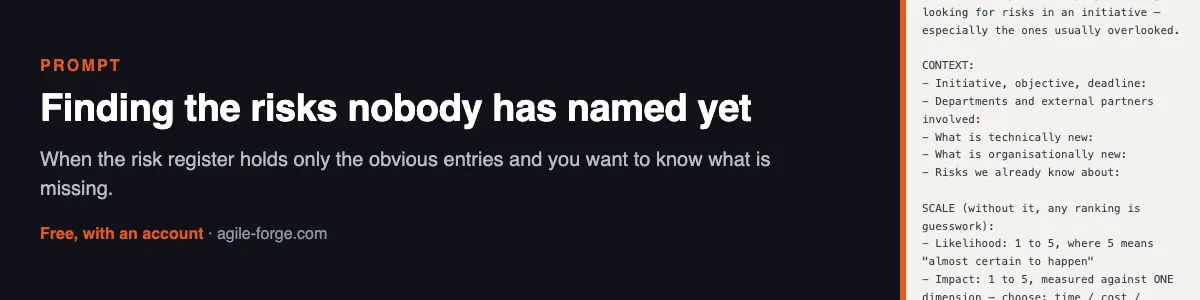
Have a look. The account is free.
Where it reliably gets things wrong
A language model has no model of your project. It has a model of what work breakdown structures usually look like. From this follow three errors that occur reliably:
It does not observe the 100% rule. The output looks complete because it is symmetrical — every level has three to five items, everything looks tidy. But symmetry is no proof of completeness. Real projects are asymmetrical: one branch has twelve work packages, the next has two.
It structures by phase unless you stop it. That is the most common structure in the texts it learned from. Give it no criterion and you get preparation/execution/closure — that is, exactly the variant that holds up least well.
It invents the plausible. Work packages that have no substance in your context but sound good. This is harmless as long as someone with subject knowledge reads over it, and expensive when the plan goes into the estimate unchecked.
All three errors have one thing in common: they cannot be spotted from the output. They look like a good plan. That is why, here, the language model is a tool for someone who can judge work breakdown structures — not one that replaces that ability.
Frequently asked questions
What is a work breakdown structure?
The decomposition of an undertaking into ever smaller parts, down to units that can be estimated, assigned and completed — the work packages. It answers a single question: what belongs to this project and what does not. Schedule, cost and accountability all hang off that answer.
What ways of structuring are there?
Three: deliverable-based (by partial result), function-based (by type of work) and phase-based (by sequence). The phase-based structure is the most obvious choice and therefore the most common mistake — it tells you when something happens, not what is produced. A mixed top level is acceptable, as long as each level sticks to one criterion.
What is the 100% rule?
The plan contains all the work of the project and nothing beyond it. Each level fully represents what sits in the level above. This is the rule that separates a work breakdown structure from an arbitrary task list; it is set out in the PMI Practice Standard for Work Breakdown Structures.
Work breakdown structure or schedule — what is the difference?
The work breakdown structure shows what is produced. The schedule shows in what order and when. The structure comes first: until you know what belongs to the project, you cannot put anything in sequence. Conflate the two and you end up with a phase-based structure — a plan that does not carry the information you built it for.
Can a language model create a work breakdown structure?
A draft yes, a dependable plan no. Three failures occur reliably: the output does not observe the 100% rule and only looks complete because it is symmetrical; it structures by phase unless you specify otherwise; and it invents plausible-sounding work packages with nothing behind them. None of these is visible in the output. The real gain runs the other way: hand it your finished plan and ask what is typically missing.
Related course
Managing projects with AI
Nine modules on one continuous case project — from prompting to governance, practised on real project documents.
View the course →Episode 03 of the series
AI in everyday project work
The video above is episode 03 of 11. Each episode solves one project task live with AI — all are available, in a sensible order.
See all episodes →
Philip Müller
Trainer and consultant for project management, agile methods and AI in day-to-day project work.
About the author →Newsletter
What actually works in day-to-day projects, roughly once a month.
New articles, tools, and what has held up when using AI on real projects. No sales talk, no roundup of news you have already seen.
I would like to receive occasional emails from Agile Forge about courses, new content and offers. You can unsubscribe at any time with one click. I never pass your address on. Read the privacy policy