
Fundamentals
Stakeholder analysis — why the list can be complete and the analysis still worthless

24 August 2026
Most stakeholder analyses are complete and worthless all the same. They are put together during the kickoff week, fill a table with twenty rows, get filed away — and the moment the first escalation hits, it turns out that the person who can stop the whole thing isn't even on the list.
This is rarely down to carelessness. It is down to the analysis answering the wrong question: it records who is involved. What would actually be useful is knowing who can block the project and why they might want to.
What a stakeholder analysis is meant to achieve
Stakeholders are everyone who can influence the project or is affected by it. The second half of that sentence is routinely skipped over — and that is exactly where you find the people who will later slow things down: the works council, the data protection officer, the team whose workflow changes without anyone asking them.
The analysis has three jobs, and only the first is done reliably:
- Identify — who is in the picture at all?
- Assess — how much influence does someone have, and how much does the project affect them?
- Derive — what does that mean for how you work together?
Without the third step, the analysis is a list of names with colours.
The matrix everyone uses
The most widespread tool is the power-interest grid, which goes back to Aubrey Mendelow: a four-quadrant matrix of power and interest. High power and high interest means close engagement; high power and low interest means keep them satisfied without overloading them; and so on.
The grid is useful, but it has a weakness that gets expensive in day-to-day project work: it captures a state, not a behaviour. Interest shifts the moment the project actually reaches someone. A person with low interest in week two can be the loudest critic by week twelve — not because their stance has changed, but because that is when they first grasped what was being planned.
The more nuanced model by Mitchell, Agle and Wood therefore adds a third dimension: alongside power and legitimacy, urgency. Where someone has all three attributes, delay costs the most.
For practical purposes, a simpler rule usually does the job: next to each person, add a column for what they gain if the project succeeds and what they lose. Anyone who cannot fill that column has not analysed the person, merely noted them down.
Where a language model genuinely helps
The benefit lies where you wouldn't expect it. Assessing individual people is the part a model cannot take over — and, for data protection reasons, should not. It is all the more useful for the groundwork that comes before.
The completeness check. You describe the project in a few sentences — no names — and ask: which roles are typically affected by a project of this kind and are regularly overlooked? The answer reliably includes the things nobody thinks of during the kickoff: the works council, data protection, procurement, the external auditor, the department that maintains the legacy data. This is the most valuable application, because it addresses the most common mistake.
Framing interests. Working out the interest behind a position is tedious, and a model can guide you through it. "Procurement is against the new system" is a position. "Procurement is responsible for an existing framework agreement and would have to justify cancelling it" is an underlying interest — and only the second gives you something to work with.
Preparing for conversations. Drafting questions that reveal a stance rather than merely confirm it. This, too, is a matter of wording, not assessment.
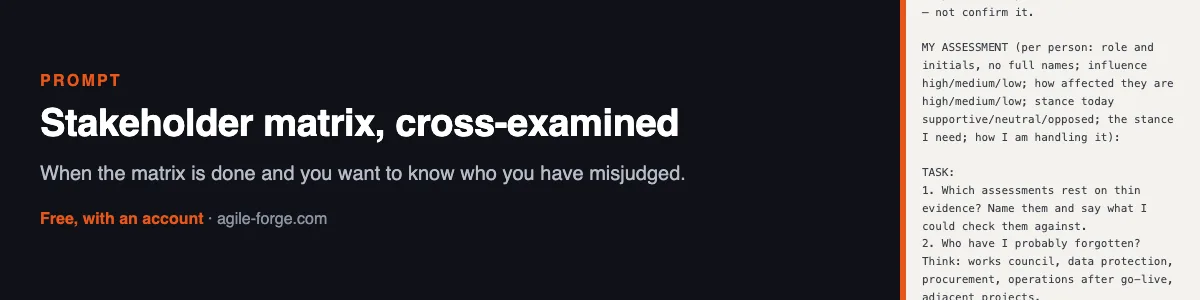
Have a look. The account is free.
Where the line falls differently
With most project documents, the question is whether a language model delivers usable results. With a stakeholder analysis, a second question comes first: whether you may feed it in at all.
A stakeholder analysis contains names, functions and judgements about identifiable people — right down to notes like "opposed to the project". This is personal data, and the judgement is the most sensitive part of it. Entering it is permissible only where two things are in place: a legal basis under Article 6 GDPR and — where the provider acts as a processor — a contract under Article 28 GDPR. If either is missing, the input is not permissible, regardless of how useful the result might be.
The workable separation is: roles yes, people no. "Head of Procurement" instead of the name, "works council" instead of the chair. For the completeness check and for framing interests, the role is entirely sufficient — it is in fact the better input, because it doesn't tempt the model into statements about individuals. Mapping names to roles happens afterwards, in your own records.
This is not a formality to be ticked off. It is the point at which the difference between "we use AI" and "we use AI responsibly" actually becomes visible — and precisely the competence Article 4 of the EU AI Act presupposes: the provision obliges providers and deployers to ensure a sufficient level of AI literacy among the people operating such systems on their behalf.
Frequently asked questions
What is a stakeholder analysis?
The systematic identification of everyone who can influence an undertaking or is affected by it, together with an assessment of their influence and their interests. It has three jobs: identify, assess, and derive what the working relationship needs to look like. Without the third step it remains a list of names with colours.
What is the power-interest grid?
A four-quadrant matrix of influence and interest going back to Aubrey Mendelow. High influence and high interest means close involvement; high influence and low interest means keeping them satisfied. Its weakness: the grid captures a state, not behaviour. Interest often rises only once the undertaking actually reaches someone — and by then the week-two classification is still sitting in the table.
How often should a stakeholder analysis be updated?
Often enough that it is worth something when a conflict arrives — in practice that means a fixed review date rather than as-needed. An analysis nobody reopens after kickoff was wasted effort. Triggers for a review are changes in scope, changes in leadership roles, and any escalation.
Can I put a stakeholder analysis into an AI tool?
Not with names in it. A stakeholder analysis holds names, job titles and assessments of identifiable people — including notes on their stance. That is personal data, and the assessment is the most sensitive part of it. Entering it is permissible only where two things are in place: a legal basis under Article 6 GDPR and — where the provider acts as a processor — a contract under Article 28 GDPR. The workable split is roles yes, people no — “Head of Procurement” instead of the name. For the completeness check, the role is all you need.
Where does a language model help with stakeholder analysis?
Not in assessing people — it cannot and should not. It helps with three other steps: the completeness check (which roles tend to get overlooked in projects like this?), turning stated positions into underlying interests, and preparing conversations. All three are drafting work rather than judgement — and all three work without a single name.
Related course
Managing projects with AI
Governance under the EU AI Act is a module of its own — including which project documents a tool may see and which it may not.
View the course →Episode 06 of the series
AI in everyday project work
The video above is episode 06 of 11. Each episode solves one project task live with AI — all are available, in a sensible order.
See all episodes →
Philip Müller
Trainer and consultant for project management, agile methods and AI in day-to-day project work.
About the author →Newsletter
What actually works in day-to-day projects, roughly once a month.
New articles, tools, and what has held up when using AI on real projects. No sales talk, no roundup of news you have already seen.
I would like to receive occasional emails from Agile Forge about courses, new content and offers. You can unsubscribe at any time with one click. I never pass your address on. Read the privacy policy