
Field Notes
Agile Team Coaching: What a Workshop Actually Delivers — and What Only Comes After
10 September 2026
Seven building blocks from coaching a team, from settling the brief to anchoring the work in a weekly rhythm.
The brief was to improve what was already there: a set of goals and topics that had grown over a long stretch of time.
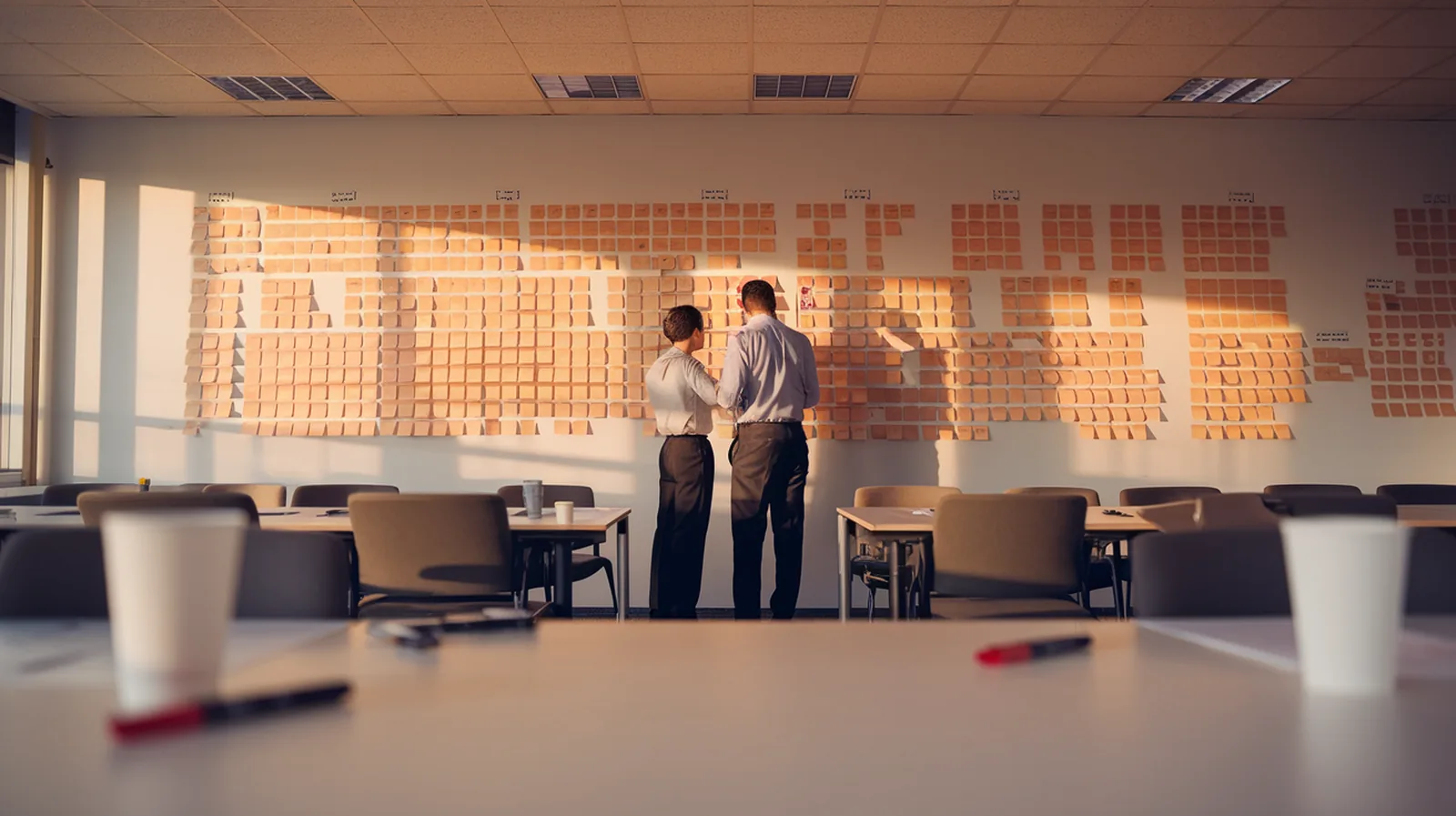
A few hours later, something else was on the wall. What already existed would not be the starting point. The team would build the new structure along a pattern that had proven itself elsewhere, and fill that pattern with its own goals.
The reflex would have been to steer it back: the brief stood, and the new route meant more work. I did not do it.
Several changes of direction and a good deal of arguing sat between those two points. Not because nobody knew what to do, but because the real question was something else entirely: what is part of this piece of work, and what is not?
From outside, that could have looked like a detour. For the team it was the decisive work of the first phase. Before requirements could be sorted, packages written and priorities set, it had to be clear what was actually being worked on. That was the job.
Who this is for: teams that already work in an agile way and are facing a piece of work that does not fit into day-to-day operations. Too big for one card, too long-running for one week, with no place on the existing board.
The case described here ran across several connected blocks of work. The building blocks work in shorter formats too, because they follow phases rather than a calendar. The whole thing falls into three phases: clarify, structure, anchor.
A team that already works in an agile way
A small team that had already been coached for a while.
That difference matters.
The job was not to explain Scrum, introduce Kanban or teach fundamentals. The team already had a way of working; what it lacked was a place for a piece of work that did not fit into it. That is why the group stood in front of a wall instead of a slide.
It had been different when we started working together. The team began with Scrum, and I took far more of the lead back then: I set the dates, facilitated the meetings and chased the open points.
Later the team moved to Kanban on its own.
That rhythm is established now: a daily sync plus a weekly and a monthly slot. The same logic ran during the workshop, only in analogue form on the wall. The step still outstanding is moving it onto the digital board.
Ownership grew as well.
It is now a fixed part of how the team works, and the workshop showed it again. Even in messy situations the team looks for a solution, because the point is a shared goal rather than whose job it is.
For me that meant a different role: provide structure without taking over the content. The moment I decide on content, the result belongs to me at least in part — and it becomes harder to hand over.
Phase 1: Clarify — the brief before the work
So the first important decision was not about a method. It was about the brief.
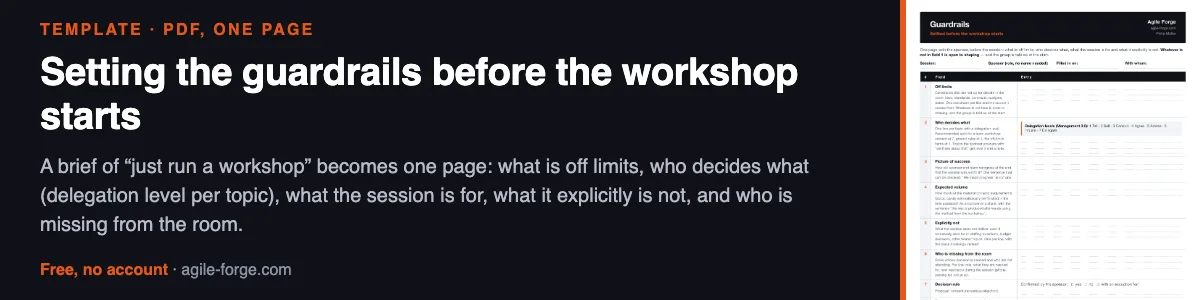
Before a workshop like this, one page of guardrails is worth the effort:
- What is fixed and not up for discussion?
- Who decides what?
- What should be true by the end of the session?
- What is explicitly not part of it?
For distributing decision rights, the Delegation Poker scale from Management 3.0 is one option. What matters is less the method than clarity about how much latitude each person has.
Opens straight away, no account
In this workshop the content decision sat with the team. That is what allowed it to question the original brief.
"We improve what exists" turned into "we build something new, modelled on a pattern that already works."
Every team facing material that has grown over a long time knows this decision: build your own, or adopt something proven and adapt it. Here it was taken not at the start but once the scope was on the table. And it created more work than the original plan. It was still the right call.
The guardrails had a limit, though. The actual scope of the work had not been settled beforehand. That question took up a large part of the first phase.
That is one of the uncomfortable truths about workshops: whatever is not settled in advance usually gets settled at the beginning — only under time pressure.
Have a look. The account is free.
Deciding by objection instead of arguing to exhaustion
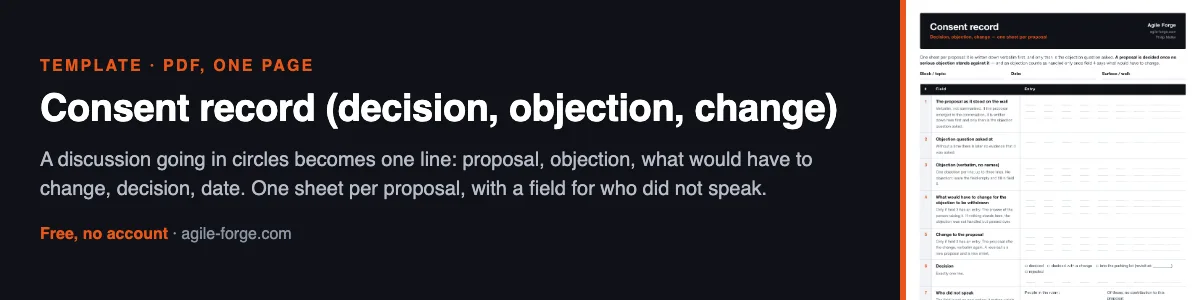
The direction was decided by the objection question. A proposal is decided once nobody raises a serious objection to it. The approach comes from sociocracy and reached agile practice largely through Sociocracy 3.0.
That is not the same as looking for agreement. Agreement asks everyone to say yes; the objection question asks something narrower, and the difference shows less in the result than in the question that gets asked.
A proposal is made visible, and then the room is asked: is there a serious objection? If there is none, the decision is made. If there is one, the next question follows: what would have to change for you to withdraw it?
An objection is then neither a veto nor an irritation. It becomes information about what the proposal is still missing.
For this team that helped, because the direction really did change early on. The decision did not linger as a vague mood; it became something the group could see and work on together.
Opens straight away, no account
Three rules that carried the whole session
Out of the first hours of work came three rules that held for the rest of the session:
- Everything goes on the wall. What is only said is gone shortly after.
- Decide with the objection question. Is there a serious objection? If so: what would have to change?
- Every block ends with a result. A photo, or a visible entry on the wall.
These rules did not have to be explained again and again. They were on the wall, and the team increasingly applied them on its own.
Phase 2: Structure — turning a pile of cards into order
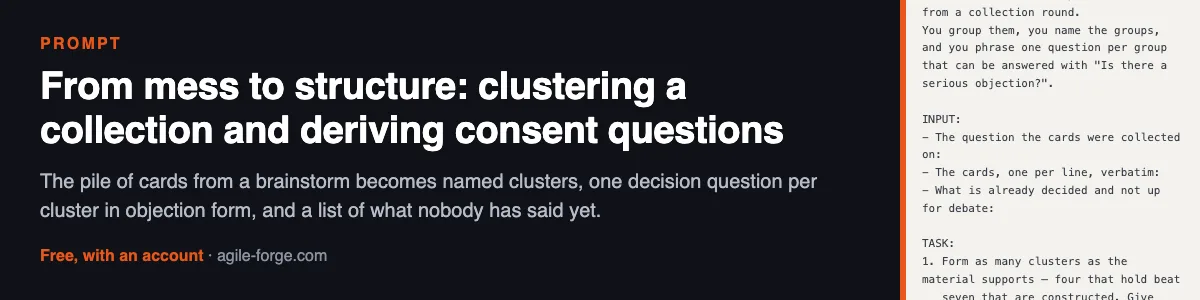
The second phase opened with a large collection of requirements and ideas already in hand. Now the structuring work began, and the sequence was deliberately plain: cluster, develop criteria, prioritise, write out.
First, everything already collected was made visible on the wall. Then cards were grouped by topic.
Only after that did the team develop criteria for telling whether a package actually holds together.
Prioritise first and you usually decide by feel. Sticky dots only make that feel visible; criteria give the group a shared yardstick.
Have a look. The account is free.
So before prioritising, one more question came up: how much can the team actually take on alongside day-to-day operations?
The aim was not to get as many cards as possible into a "first" column. If capacity covers only a certain number of topics, not everything can be a priority at once.
The team knows its own board and its own working rhythm better than any external coach. So it drew that line itself — when we started working together, that question would probably have landed with me.
Pairs work, the coach moves
After the shared structuring, the work continued in pairs.
Each pair took on one package: ordering content, assigning goals, fleshing out requirements.
The pairs were split by topic. Where a topic reached into several packages, nothing was passed between the groups on sticky notes; the pairs concerned talked it through directly until they agreed on one line.
Rather than sitting down with one pair and working on the content, I rotated between the groups.
Listen briefly. Ask one question. Move on.
For example:
- Who is this package for?
- What can somebody do afterwards that they could not do before?
- How would you tell that it works?
Barely any input, a large effect — and that was the point.
The work was subject-matter work, and that is exactly what stayed with the team. I stepped in at two moments: when a discussion ran into a dead end, and when one pair was visibly stuck while the others had moved on. Then I swapped people, so experience went where it was missing. The rest was invisible, right down to who walked to the printer.
When we started working together, I had to create structure and lead discussions. By now the craft lies in not stepping in when the team finds the answer itself.
A good coaching day therefore does not end with me having contributed a lot. It ends with the team needing less of it than before.
A workshop needs a memory
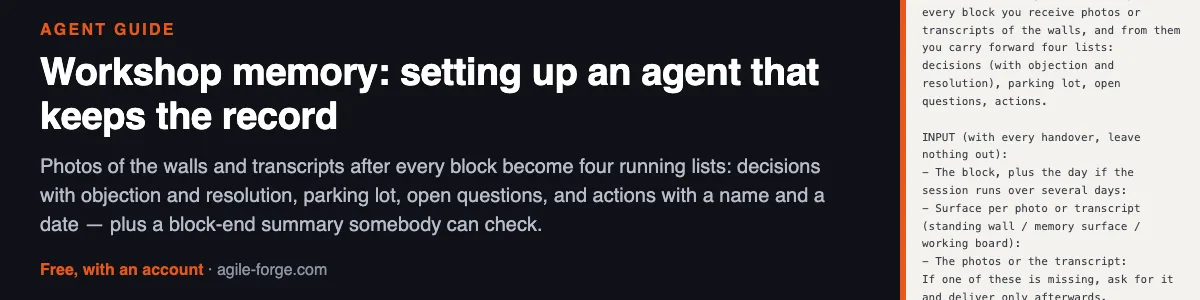
A longer session produces a lot of decisions, questions and intermediate states. Without a clear structure, a surprising amount of that disappears between the working blocks. So we used three surfaces, each for a different purpose:
The standing wall stayed up and was never wiped.
The memory surface held the goal, the guardrails, the ground rules, the criteria and the parking lot.
The working board was photographed after each block and then cleared again.
That sounds trivial, but it prevents a familiar problem: the next morning everybody remembers something different.
Have a look. The account is free.
The parking lot came with one clear rule: anything that could not be decided in short order was parked visibly and given a date to be picked up again.
What got parked above all was a question that surfaced early and would have derailed the agenda: what is not covered at all so far? Those gaps were collected and assigned to topics in the last phase. The same went for topics reaching beyond the session; they are now on the list for the project work ahead.
A parking lot only works if the promise is kept. Putting a topic aside does not end a discussion. It moves it.
Phase 3: Anchor — turning work into commitment
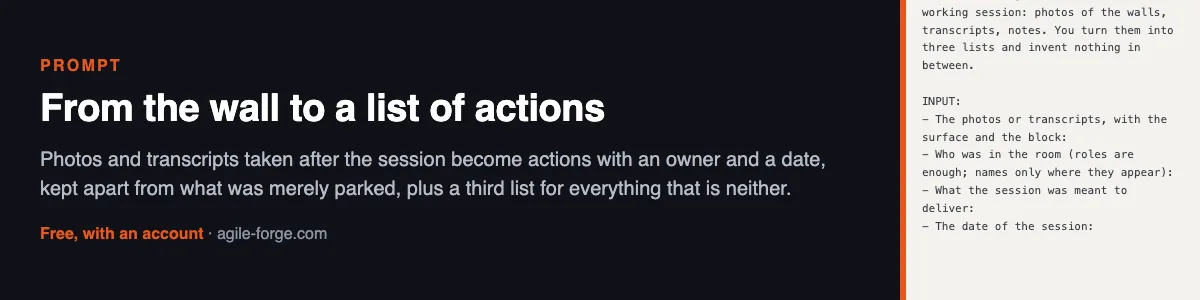
The last phase was not about producing more cards. Now the structure had to be anchored so that it would survive the workshop. Two plain rules applied: no "we", a name instead. No "soon", a date instead.
Every action was read out loud and confirmed by the person responsible, which turned a note into a commitment.
Have a look. The account is free.
Three decisions mattered most here.
First, the work was made visible as a project of its own on a new Kanban board, separate from the board for day-to-day operations. During the session it hung on the wall in analogue form; next it moves into the same digital environment the team works in anyway.
Second, the topic got a fixed slot in the weekly team meeting. That looks like an administrative detail, but in practice it decides whether a workshop result survives. A project with no place in the calendar or in the flow of work gets pushed out by day-to-day business.
Third, what stood at the end were dates rather than intentions: working sessions per subgroup in the weeks that followed, plus the weekly slot as the ongoing rhythm. What matters is not the number but that the invitations went out while everyone was still in the room. The team set the approach for those sessions itself: cluster goals into packages, determine order and effort, then align between the groups.
The close: three questions, in this order
The session did not end with a general feedback round but with three questions. The order was fixed, and the first one mattered most, because that is what the team carries on with.
First question: in two weeks you are sitting in a pair in front of one package. What do you do first, what next? The answers went onto cards and were numbered. What came out of that is the team's own operating instructions for the time after the workshop.
Second question: what has to happen for you to be genuinely further along in four weeks, rather than merely well-intentioned? Going round the room, the answers were sorted into three columns: time (hours and dates), tools (files and templates), and decision (who has to sign something off). Every item went straight into the action plan.
Third question: what feeling are you leaving this session with? One card per person, no discussion.
The order is what makes it work. Start with the feeling and you get mood, and no commitment afterwards. Start with the concrete step and you get both.
What was actually finished
The new structure was not finished. And that was never the result the session was meant to deliver.
What the team had at the end was something else:
- a settled scope,
- a shared goal structure,
- one coherent structure instead of a collection of separate improvements,
- ordered requirements,
- assigned goals,
- a board of its own,
- named responsibilities,
- and a fixed place in the weekly working rhythm.
You cannot work from that yet. But everything that follows hangs on it.
The decisive difference from before, though, was not on any of those cards. The team had produced not only a result but a way of working it can continue without outside facilitation.
That, to me, is how the success of coaching like this should be measured: not by how many cards hang on the wall, but by whether the group can carry on the next morning without the coach.
The seven building blocks at a glance
- Settle the guardrails in advance. Before the workshop, fix what is not up for discussion, who decides what, and how success will be judged.
- Decide by objection, not by agreement. Do not hunt for everyone's yes; surface serious objections and work them through.
- Cluster, criteria, prioritise. Create order first, then a shared yardstick, and only then set priorities.
- Pairs, with the coach rotating. The team works on the content while the coaching provides structure, asks questions and deliberately steps back.
- Parking lot and memory surface. Keep open topics visible and make sure decisions and intermediate states do not get lost.
- Actions plus a fixed slot in the weekly rhythm. Give responsibility a name and a date, and anchor the follow-on work in the rhythm that already exists.
- Close with three questions. The next concrete step first, then what is missing for it, and the feeling only at the end.
Transferable — and where it stops
The approach is not tied to any particular subject.
The same logic can work when a product backlog has to be re-scoped after a change of strategy, when a service portfolio needs prioritising, when a research group orders its projects for the coming year, or when a sales team redraws its target segments.
What these situations share is a starting point: the team knows the material, the goal exists, the structure is missing.
Not every problem is a workshop problem, though. If the goal has not been named, if the people who decide are not in the room, or if what actually needs settling is a leadership or budget decision, no amount of good wall work will help.
A workshop can make a missing decision visible, but it cannot replace it.
What a workshop does not do
A session of this kind produces a solid basis to work from, not a finished product. The real work begins afterwards.
The building blocks have preconditions too. The objection question does not work if objections are only voiced outside the room. An action board does not work if nobody takes responsibility. A fixed weekly rhythm does not work if day-to-day business pushes it aside the first time things get busy.
Two points I consider critical in this situation. The first: the weekly slot has to be in the calendar rather than convened as needed. A rhythm that has to be convened each time will not be convened on the first busy day. The second: one person has to hold the overall picture while the groups work on their parts. Otherwise you end up with several tidy fragments and no shared whole.
Then there is what a workshop fundamentally cannot do. One point stayed open because it could not be decided in the room. The team marked it as a blocker, visible to everyone. A workshop can do no more with it than that, and should do no less.
Which is why coaching does not necessarily end with the last workshop block. The decisive question is whether the team keeps the new way of working once nobody from outside is watching.
If you want to try this yourself
Free in this article, with nothing to sign up for: the seven building blocks above and the three rules. Copy both and put them on the wall in your next session.
The six pieces linked above all cost nothing. The public resources page shows everything openly — the title, the purpose and the context of each resource, plus the two templates as a direct download; only the prompt texts themselves need a free account.
If you have a specific project ahead of you, the first thing to settle is what you actually need: a workshop, facilitation, or longer-term team coaching. A conversation about that costs nothing.
See how the coaching works · Agile transformation: workshop, training or consulting — what fits when? · Agile transformation: consulting and support
In closing
The most important difference between this session and the coaching at the start of the collaboration was not a new method. It was that I was needed less at the end than at the beginning.
My job was not to accompany the team for as long as possible. It was to create a structure the team can then carry itself.
Whether that works is therefore not decided in the last block. It is decided in the weeks that follow.
Is the new board still standing? Is the weekly slot still happening? Are decisions still being made by the team?
Those are the questions that show whether a workshop has actually led to the team working independently.

Philip Müller
Trainer and consultant for project management, agile methods and AI in day-to-day project work.
About the author →Newsletter
What actually works in day-to-day projects, roughly once a month.
New articles, tools, and what has held up when using AI on real projects. No sales talk, no roundup of news you have already seen.
I would like to receive occasional emails from Agile Forge about courses, new content and offers. You can unsubscribe at any time with one click. I never pass your address on. Read the privacy policy